


Article Outline:
These days, Catholic organizations are navigating higher expectations, tighter budgets, and more platforms than ever before. Without a clear plan, even good content can feel scattered and fail to live up to its full impact. Successful Catholic marketing strategies help focus your efforts on what works and align your communications with your mission.
The 5 Stones Catholic marketing agency put together the tips below to help you plan. They reflect what is working for major Catholic organizations in 2026. If you’d like to get more specific guidance on how you can strengthen or expand your current Catholic marketing strategy, don’t hesitate to reach out to our team!
→ Get in touch.
Good marketing is built in layers, which we often visualize as a pyramid for our clients. The success of each layer is built upon the stability of the one before. When Catholic organizations come to us for marketing, we don’t just focus on tactics and execution. We look at their marketing strategy as a whole and help ensure each layer is well-thought out and able to support success in the others.
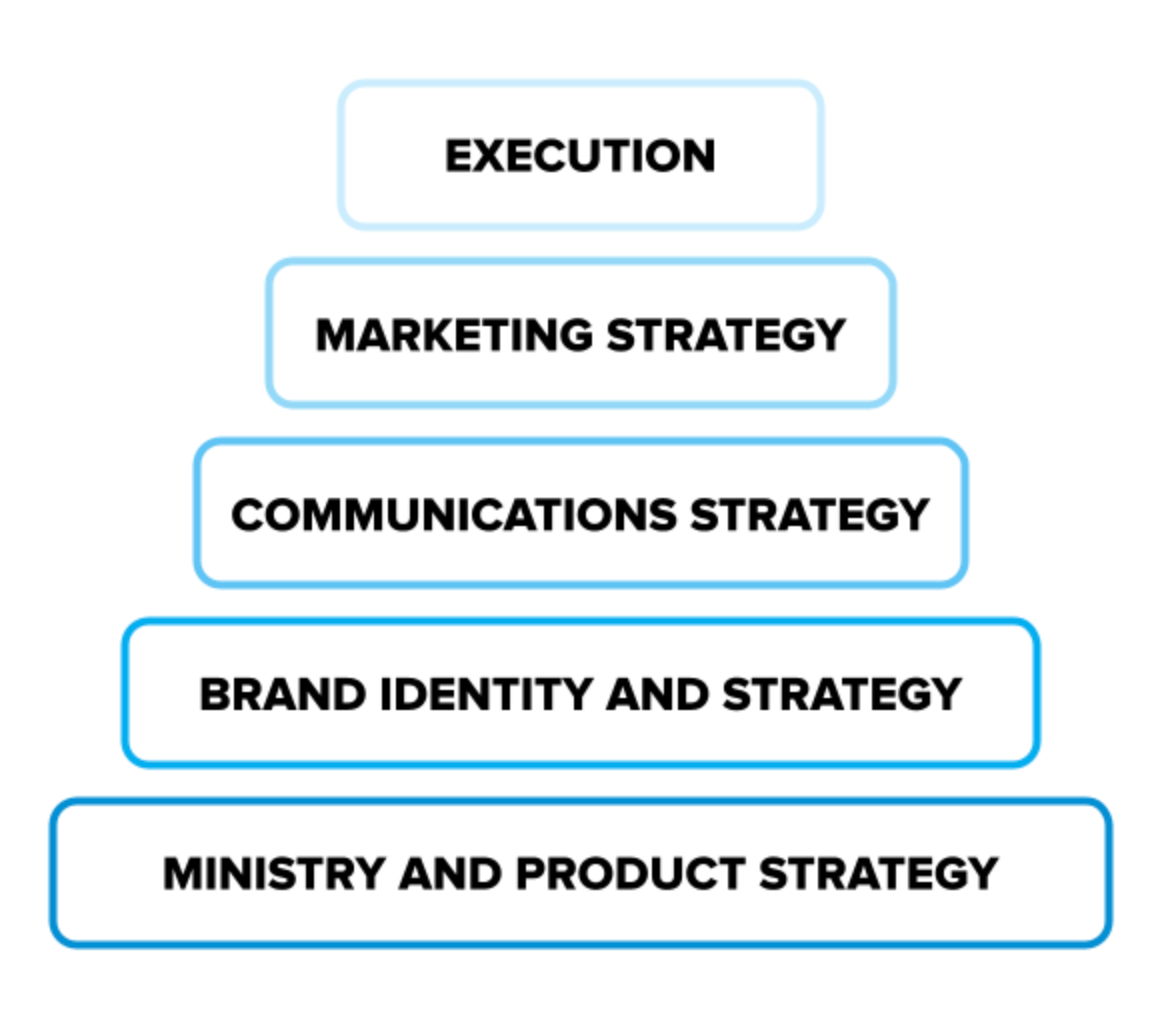
Without this foundation, everything above it lacks direction. If you are unclear about your mission focus, your audience, or how you serve them, your brand and messaging will drift.
Your brand is a promise. It’s how people talk about you when you’re not in the room—what makes your fans love you and your detractors dislike you. If this layer is weak, communications become fragmented and your story weakens. Different campaigns start to feel like they belong to different organizations and it becomes harder for your audience to develop a relationship with you. Here are four questions to sharpen your Catholic brand strategy!
You know the types of things you need to say to your audience and where they can be found. Now you need to figure out the best way to deliver your message. This is a part of bridging your brand strategy into a marketing strategy. If this layer is skipped, marketing becomes reactive. Emails, social posts, and campaigns may perform in isolation, but they won’t build toward a larger goal.
This is the concrete plan for channels, timelines, and initiatives. Without it, execution turns into activity without direction. Your team stays busy but struggles to move people toward meaningful action.
This is the visible work: ads, emails, websites, content, etc. The efficacy of these tactics reflects the strength of the strategy beneath them.
—
When any one of these layers is rushed or overlooked, the strain shows up higher in the structure. That’s why 5 Stones doesn’t just specialize in one particular aspect of execution. We build well-rounded, carefully thought out Catholic marketing strategies for our clients so that they can make the most of limited budgets and reach more souls with their mission.

Effective marketing begins with knowing where you want people to go or what you want them to do. For Catholic organizations, this often means guiding people gradually toward deeper participation rather than asking for a major commitment right away. Each touchpoint should help someone understand what they can do next and move them down the “funnel” to the action you want them to take (such as buy, register, or donate).
Successful Catholic organizations use the customer journey to guide the strategy of their email automations, ad campaigns, and more. Here is a quick breakdown of the different phases and what they look like in practice:
This content introduces your organization and mission with the goal of helping people recognize who you are and what you offer. Each piece should help your audience understand you better and keep you top of mind. Great brand awareness content can include social media posts, ads, short videos, and other shareable content.
Content at this stage should build value and familiarity. Event pages, blog posts, landing pages, and informational emails help keep the relationship alive. You want your audience to stay connected and interested in what you do.
Build empathy and authority at this phase. Show your audience that you understand their desires and their problems and have the ability to solve them. The clearer you paint the vision of the outcome they want, the more people will trust that you know how to get there.
At the decision stage, your audience is interested but weighing their options. They may be comparing your organization to other ministries, programs, or ways to spend their time and resources. This is a natural part of discernment, and your marketing should support it respectfully.
Content at this stage helps address common questions and hesitations. Comparative pages, testimonials, and clear explanations of what makes your organization or product distinct can be especially helpful. You might consider print pieces at this phase in addition to Catholic digital marketing.
When handled naturally, this kind of content feels helpful instead of pushy. These messages work especially well in email sequences and ad retargeting, where your audience has already shown interest and is looking for reassurance before taking the next step.
Then, tell your audience exactly what you want them to do. “Register, buy, subscribe, donate…” Remember, if you sound unsure, your audience will also feel unsure. Confidence is key. This is the perfect moment in the journey to run a promotion that will tip the scales for anyone on the fence. You want your offer to be a “no-brainer!”
Once someone takes your desired action, don’t let them exit your funnel just yet! Your lowest cost per acquisition will always be engagement from people who have already interacted with your organization.
Email remains one of the most effective tools for nurturing these relationships. It allows you to:
Followers, subscribers, attendees, and past donors are more likely to engage again when communication remains consistent. This is a great reason to invest in strategic organic content.
—
Don’t have the capacity to create ongoing email or social content? Our Catholic creative team would love to help support your mission! Reach out anytime to discuss partnership with 5 Stones.
→ Get started.

Different content formats serve different purposes, and not every message belongs on every channel. Choosing formats intentionally helps your team focus effort where it matters most.
Organic content builds familiarity and trust over time. It keeps your organization top-of-mind and gives your audience the opportunity to take small, low-commitment actions. Paid content extends reach and supports specific goals such as events, enrollment, fundraising, or distribution. Used together, they help ensure your message reaches both current supporters and new audiences.
Catholic audiences already share a rhythm shaped by the liturgical year. Church marketing strategies are more effective when they align with these patterns.
Advent, Lent, Easter, feast days, enrollment periods, and major events naturally create moments of attention and readiness. Especially in parish marketing. Planning campaigns around these rhythms helps communication feel timely and relevant. Working ahead within these cycles also reduces last-minute pressure and allows teams to be more intentional.

It’s important to define what success looks like for your faith-based marketing strategy. This is one area where a nonprofit marketing strategy may differ from that of a for-profit organization. Clear goals help ensure marketing efforts support your mission in a measurable way.
Setting S.M.A.R.T. goals—specific, measurable, achievable, relevant, and time-bound—establishes the clarity and direction you need to set expectations and know what’s working. Then you can iterate and recalibrate. This is essential to achieving results from your Catholic marketing plan.
Plan to review data regularly so your team can refine messaging, timing, and channels. That way your marketing efforts will continue to improve and serve your mission well.
If you’re ready to take a more intentional approach to your marketing, the 5 Stones team would be honored to walk with you. We work alongside many Catholic organizations—from major apostolates to smaller ministries with a narrower focus—to refine their messaging, build a marketing strategy, strengthen execution, and support sustainable growth rooted in mission.
Reach out anytime. We would love to learn more about the mission God has placed on your heart.